
Delta County Sex Offender Checks
The Texas Public Sex Offender Registry is the main public source for a Delta County sex offender lookup. Texas DPS provides name, birth date, address, ZIP, county, and higher-education search controls. Ordinary public viewing is free and does not require an account. The system also offers a download and account-based subscriptions for people who want an ongoing service. Those choices are separate from a one-time lookup. No Delta County law-enforcement app or local registry alert program was verified, so do not wait for an app notice that may not exist.
Begin with the county filter for a broad local view. Use a name search when the person is known, and use an address search for place-based awareness. The official Texas registry search screen shows how DPS places these routes in one interface.
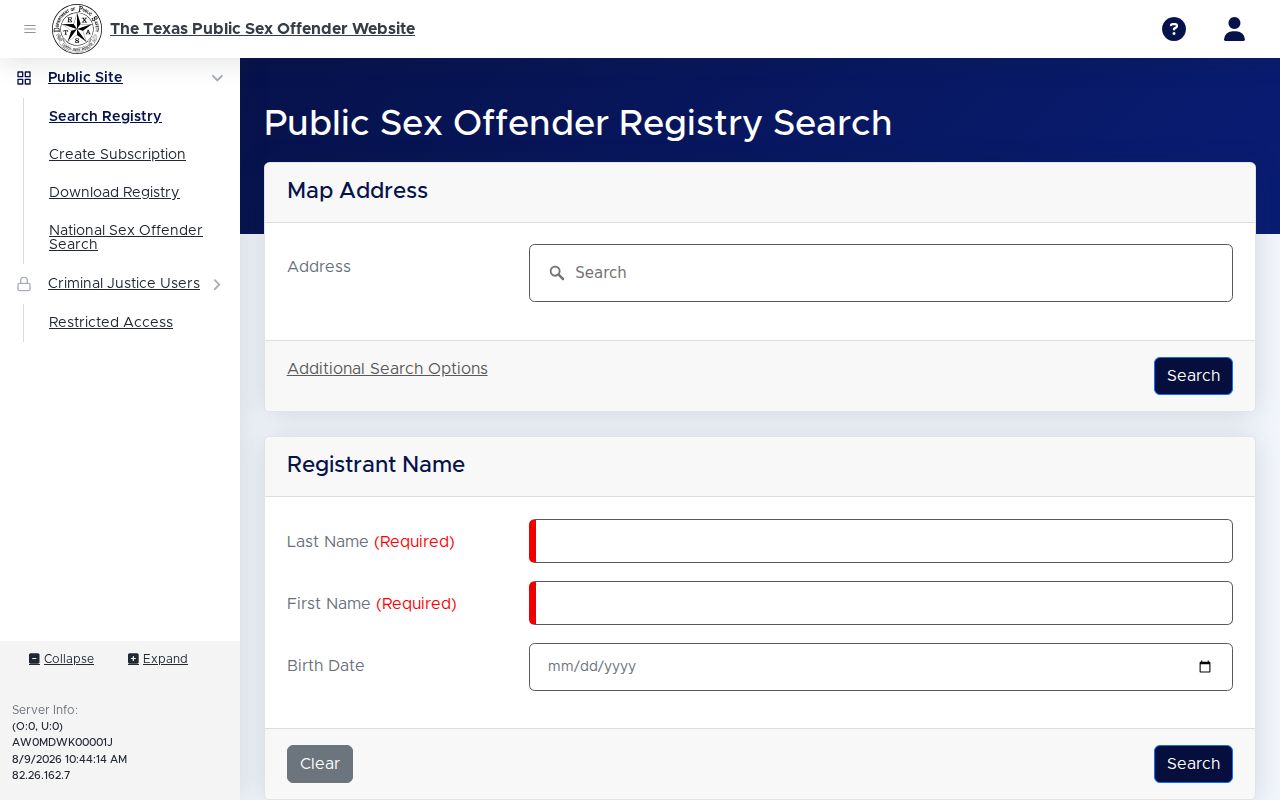
The screen is a starting point, not a finding of identity. Compare the full profile and contact its verification agency when a fact affects a safety decision.
Search Delta County Registry by County
“DELTA” appears as a specific choice under Additional Search Options. That county control is the soundest first pass for a countywide review because it does not depend on one street point being geocoded. Open the County tab, select DELTA, run the search, and then read each relevant official profile. A county result still reflects the records and status supplied to DPS. It is not a substitute for confirmation by the listed local authority.
The official DPS county-search view documents this Delta County registry route.
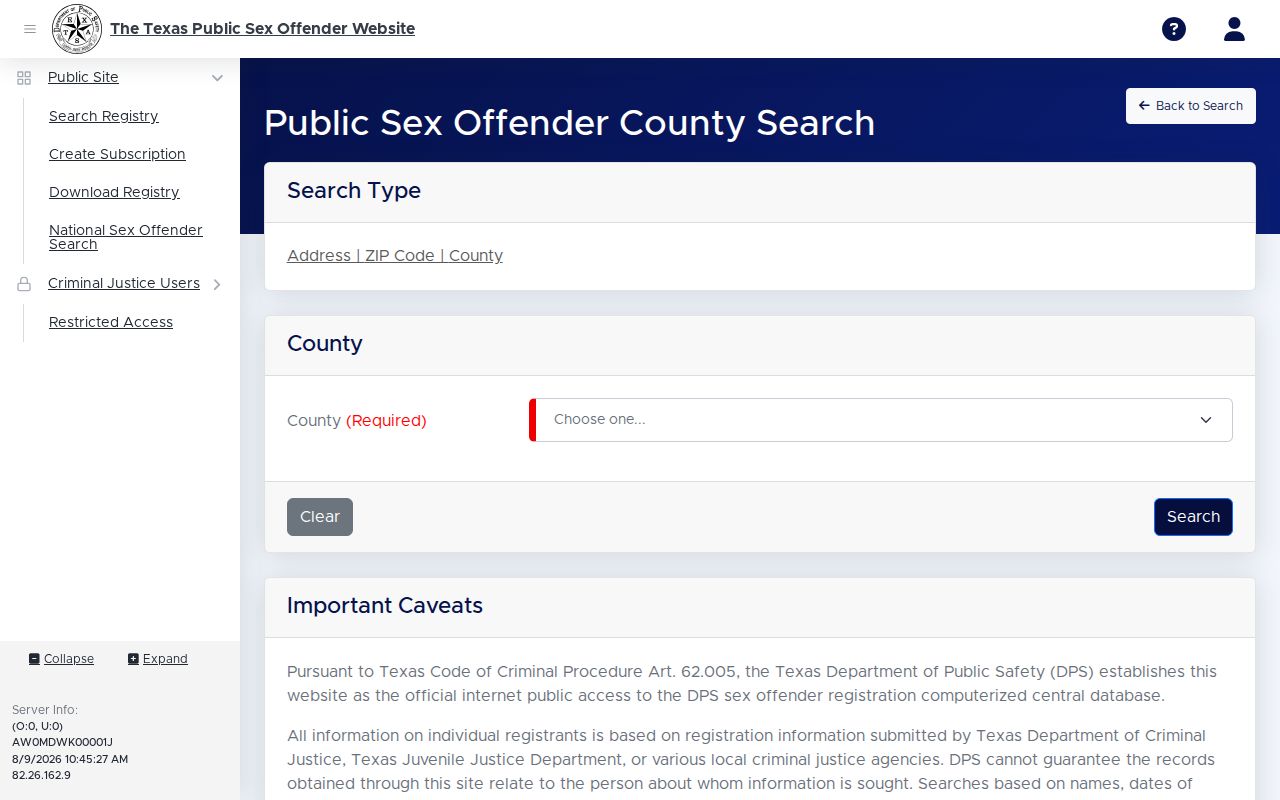
This filter is especially useful when a street address is unknown or the map does not place an entry. It also avoids treating one city name as the full county.
Note: A missing map point does not prove that the corresponding Delta County registry record is absent.
Texas Public Sex Offender Registry Searches
Texas DPS runs the statewide registry under Code of Criminal Procedure Chapter 62. The search covers public information reported through the registration system. It supports a direct name and birth-date query as well as geographic controls. Name similarity can still produce a false match. DPS identifies fingerprints, not a name alone, as the positive identification method.
- Open the Texas DPS registry and read its public-use warning before choosing a search mode.
- For a broad local check, open Additional Search Options and select DELTA in the County tab. For a known person, enter the available name and birth information instead.
- Review the result list, map status, aliases, physical details, and residence data. Do not decide identity from a shared name or date alone.
- Open the complete profile. Check the status, projected end date, verification requirement, risk entry, offense details, and named verification agency.
| Field Label | Type | Required | Notes |
|---|---|---|---|
| Map Address / Address | Autocomplete and map | Unspecified | Some addresses cannot be geocoded |
| Last Name / First Name | Text | Unspecified | A name match is not positive identification |
| Birth Date | Date or text | Unspecified | Useful for narrowing, but not conclusive |
| Institute / Campus | Dependent dropdowns | Unspecified | Campus appears after a higher-education institute is selected |
| Address / ZIP Code | Text | Unspecified | Available under Additional Search Options |
| County | Dropdown | Unspecified | Includes DELTA and UNKNOWN |
The portal also supplies Clear and Search controls. If the broad Delta County result is hard to read, clear the form before changing modes so an old address or name does not narrow the next query by mistake.
Delta County Registry Maps and NSOPW
Texas DPS does not show an ordinary selectable radius in the inspected state portal. Its Institute and Campus menus are for institutions of higher education, not a general school-distance search. An “Unmapped” label or failed address match can reflect a coordinate problem. It does not prove that no Delta County sex offender record is tied to the area. Treat the map as a supplement to the written profile and county results.
For a true cross-state address-radius option, use the federal Dru Sjodin National Sex Offender Public Website. NSOPW adds Address, City/Town, State, and Distance fields and can search participating jurisdictions. It also supports name, county, city, up to five ZIP codes, state or territory, and Indian Country. Its geographic accuracy depends on coordinates supplied by those jurisdictions.
The official NSOPW search interface illustrates the national layer used alongside a Delta County registry check.
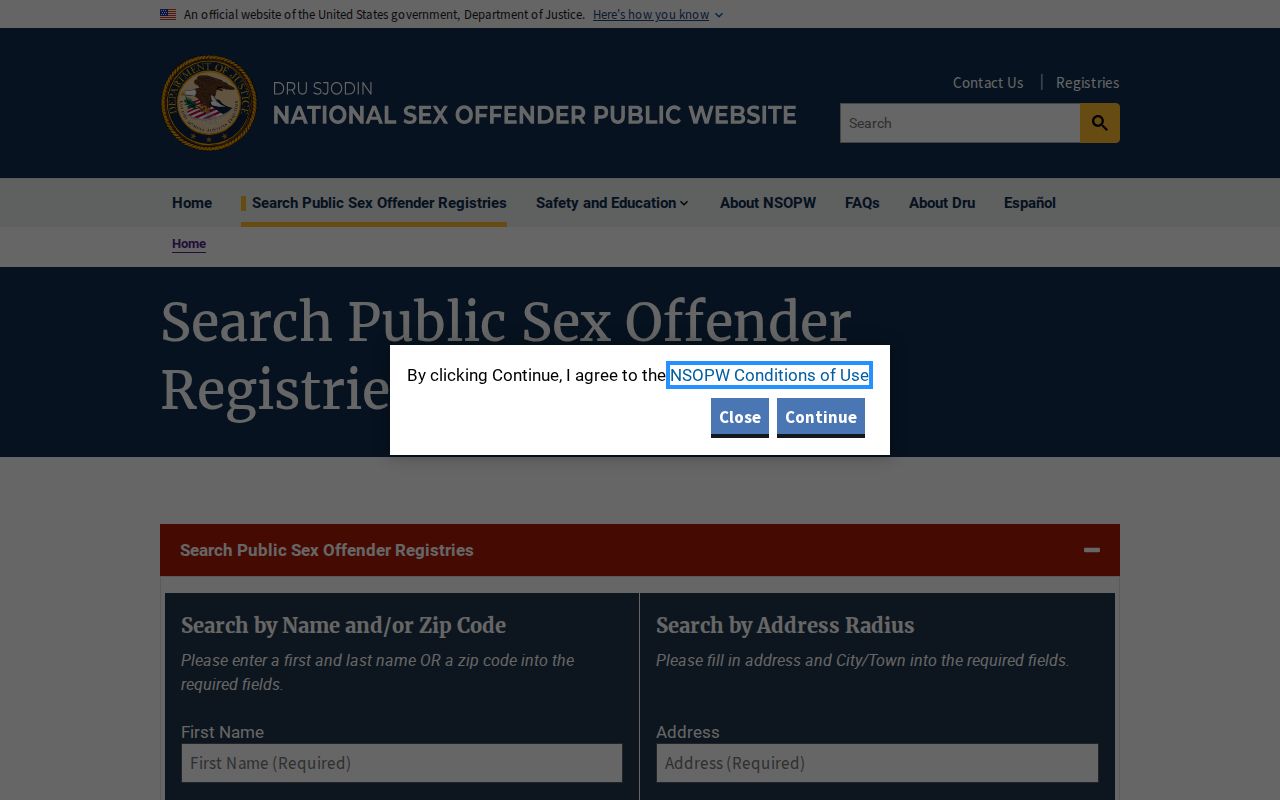
Use Texas DPS for the underlying state profile, then use NSOPW when nearby places across a county or state line matter.
Registry Profiles: What They Show
A Texas public profile gives enough detail to distinguish records and understand registration status without publishing every fact held by DPS. Visible categories can include a photograph, aliases, physical description, residence, offense and conviction information, punishment, supervision status, risk, verification facts, and a projected end date. Some vehicle and higher-education data appear when Chapter 62 makes them applicable.
| Name and Aliases | Published identifying names and aliases tied to the registry record |
|---|---|
| Photo and Description | Photograph plus sex, race, height, weight, eye and hair details, and listed scars, marks, or tattoos |
| Residence and Map | Public residence information with a mapped or Unmapped location status |
| Offense Record | Offense, conviction date, punishment, and victim-age category without the victim's identity |
| Risk and Supervision | Numeric Texas risk entry and any public supervision status |
| Registration Status | Status or end date, verification requirement, and the agency responsible for verification |
DPS withholds Social Security numbers, driver-license data, telephone numbers, online identifiers, employer identifiers, victim identities, and DPS-only information. A juvenile court may also make juvenile registration nonpublic. These limits are part of the legal record, not signs that a profile is defective.
Delta County Offender Registration Routing
Chapter 62 generally routes a person who lives inside a municipality to the municipality's chief-of-police office and a person outside one to the county sheriff. The official Cooper department menu and the official Pecan Gap municipal profile do not document a separate municipal police department for either city. That gap does not establish a new registration desk. Call the Delta County Sheriff's Office before appearing and ask which authority handles the address.
Delta County Sheriff's Office
200 West Bonham on the sheriff page
Cooper, TX 75432
903-395-2146
Verify the registration contact and street before visiting because the request page instead prints West Dallas.
Pecan Gap adds a boundary issue because the city crosses Delta and Fannin Counties. Determine which side contains the residence before choosing a sheriff or other authority. For a record error or possible noncompliance, contact the verification agency printed on the specific profile. The registry technical-support line handles portal trouble, not a person's compliance status.
Local access is not limited to a web search. Ask the sheriff which public registry information it maintains. For an existing releasable sheriff record, follow the office's written or in-person request process. State the exact record sought. Chapter 62 and other confidentiality rules still control what the office may release.
Note: Cooper and Pecan Gap lack a documented local police registry desk, so phone confirmation prevents a trip to the wrong office.
Registration Levels and Duties in Texas
Texas risk levels describe assessed danger and the likelihood of continued criminal sexual conduct. They do not operate as federal SORNA tiers, and they do not decide the registration term by themselves. Chapter 62 offense and status rules control duration. An adult duty is either lifetime for the listed lifetime categories or ten years after the later controlling release or discharge date. Juvenile duration generally lasts ten years from disposition or completion, whichever comes later, subject to juvenile-court authority over public availability.
| Texas Level | Meaning | Duration | Visibility / Notice |
|---|---|---|---|
| Level 1, Low | Low danger and not likely to continue criminal sexual conduct | The offense and status control the term, not the risk number | Public data remains subject to Chapter 62 |
| Level 2, Moderate | Moderate danger and may continue criminal sexual conduct | The offense and status control the term | Public data remains subject to Chapter 62 |
| Level 3, High | Serious danger and expected to continue criminal sexual conduct | The offense and status control the term | Heightened community notice may apply |
| Civil Commitment | Sexually violent predator status | Usually lifetime because of the underlying basis | Heightened community notice may apply |
Extrajurisdictional registration can last as long as the source federal, military, tribal, or foreign duty continues. For one person, the profile's status and end-date fields are safer than trying to infer a term from a risk level.
Delta County Registry Verification Schedules
Verification frequency is another separate rule. A civilly committed sexually violent predator verifies every 30 days. A person with two or more sexually violent offenses verifies every 90 days. Other registrants generally verify once each year. None of those intervals alone tells a reader whether the full registration term is ten years or life.
The Texas DPS Sex Offender Registration Program explains the state program and community-notification framework.
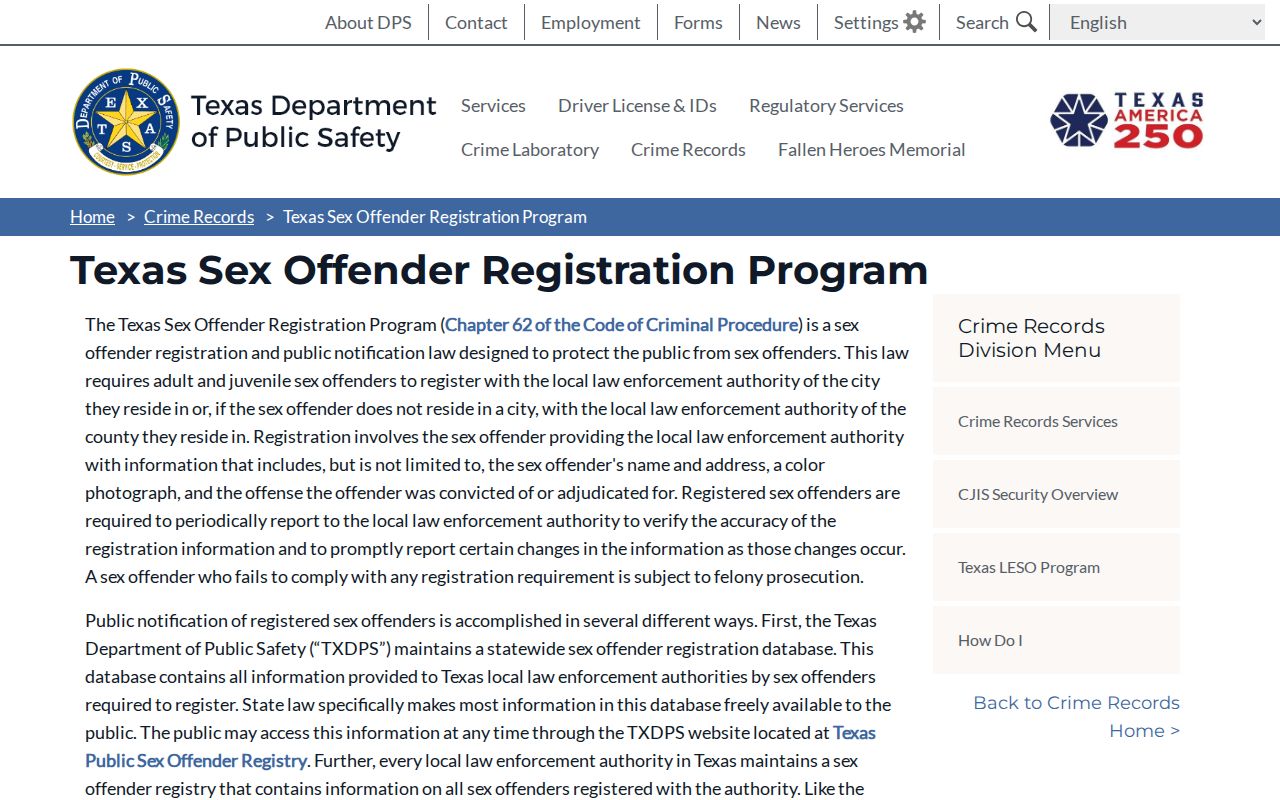
For Delta County, read the profile's exact verification requirement and agency rather than applying one schedule to every record. DPS also describes English and Spanish postcards for the immediate community around certain high-risk or civilly committed arrivals. That state process is not the same as a sheriff email alert.
Using Registry Information Lawfully
The public registry exists for awareness and personal, family, and community safety planning. Texas notification can include the DPS database, local access, legally permitted publication, and bilingual postcards in the higher-risk situations described by DPS. Use the data to understand an official record and to choose sound safety steps. Do not contact, follow, threaten, injure, or harass a person or household because of a search result.
Misuse is unlawful: Under the Texas Chapter 62 registry framework and the DPS public-use warning, using registry information for harassment, injury, or another unlawful act can lead to criminal prosecution or civil liability.
Community awareness does not remove the need to confirm identity. A photograph, physical details, aliases, and birth information can help distinguish profiles, but DPS treats fingerprints as the positive-link method. Report an urgent threat through the proper emergency channel. Send registry fact disputes to the official verification agency rather than acting on an assumption.
Correcting Delta County Registry Records
When a Delta County registry profile appears wrong, first record the profile field at issue and the date viewed. Then contact the verification agency displayed on that profile. That office is the route for an address, status, compliance, or other record question. Do not direct a compliance claim to the portal help desk.
For a technical problem with the Texas search, DPS publishes 855-481-7070, Monday through Friday from 8 a.m. to 5 p.m. The session times out after 30 minutes, so save the nonprivate facts needed for follow-up before the session closes. Do not copy or circulate a full private-person profile. If the search issue crosses state lines, check NSOPW and then return to the state or local verification agency that supplied the record.
Note: A disputed map point, name match, or end date should be checked with the profile's verification agency before anyone relies on it.