
Delta County Criminal History Checks
Begin with the record that answers the question. The combined County and District Clerk searches Delta County misdemeanor and felony cases, but its records are not online. The sheriff provides arrest, booking, jail, and offense material. The Justice Court keeps fine-only and traffic matters. State tools add public Texas conviction data, prison custody, and registry information. A label such as “Court Records” on a county service page does not turn these sources into one name-search database.
Have the full legal name, likely court level, date range, and any case, offense, call-for-service, or jailing number ready. A birth date can narrow a state name match, but it is not fingerprint identification. Follow this order:
- Ask the combined clerk for a misdemeanor or felony name search and state which court should be checked.
- Check current custody through the county Inmate Listing route or call the Delta County Jail.
- Request the sheriff booking or offense record with the best known incident identifiers.
- Read the filed court case for the charge, disposition, judgment, and sentence.
- Use an official Texas or federal system only when the search calls for that wider layer.
For a focused explanation of filed charges and judgments, use the Delta County court case lookup. Docket sheets are useful clues, not substitutes for the final file.
Why Delta County Records Need Several Searches
A booking record, court file, and Computerized Criminal History entry describe different stages. The arresting agency records the event. The jail records one custody episode. A prosecutor may reject, change, or file a charge, and the clerk then reports the court result. Texas DPS builds a person-based state history from agency reports. A mismatch can reflect timing, scope, or a missing disposition rather than a false record.
Texas uses a tracking chain to connect those events. A Class B-or-greater arrest is normally sent to DPS with fingerprints and a Tracking Incident Number. Each charge receives its own suffix. The prosecutor uses those identifiers when reporting whether a charge was accepted, rejected, or changed, and the court clerk uses them for the disposition. Delta County's combined clerk specifically reports results to DPS and the Office of Court Administration. If a DPS history lacks the outcome, a person reviewing their own record should obtain a certified disposition from the court of jurisdiction. DPS warns that a submission may never have arrived or may have been returned because of an error. An ordinary copy without the court seal is not enough for that correction route. The certified source record lets DPS match the correction to the right reported charge.
| Channel | What it returns | Main limit |
|---|---|---|
| Combined clerk | Delta County misdemeanor and felony case files | Written or counter search; not statewide |
| Sheriff and jail | Arrest, offense, booking, and current county custody facts | Does not prove the final court outcome |
| Texas DPS public search | Public Texas convictions and deferred adjudications | Name matching and reporting limits apply |
| TDCJ locator | Sentenced state custody and specified release data | Does not cover county pretrial custody |
The county clerk expressly says its records remain offline. Likewise, re:SearchTX cannot replace the Delta County counter because a Texas Judicial Council report says criminal case records are excluded from its document collection.
Official Background Checks in Texas
The Texas DPS Criminal History Conviction Name Search provides the public slice authorized by Government Code section 411.135. An account and prepaid credits are required. One credit costs $1, a card payment adds a stated percentage and transaction charge, and a no-match search still uses a credit. Opening each additional possible match consumes another credit. A CR-42 mail search costs $10 per person.
The name portal does not deliver a full rap sheet. It searches names with Soundex and can return false positives or miss a record filed under another identifier. A person reviewing their own fuller Texas history can use DPS Fingerprint Applicant Services of Texas, delivered through IdentoGO and IDEMIA. DPS states a $15 record check plus $10 FAST fingerprinting, for a $25 total.
The official DPS instructions show how the conviction search works.
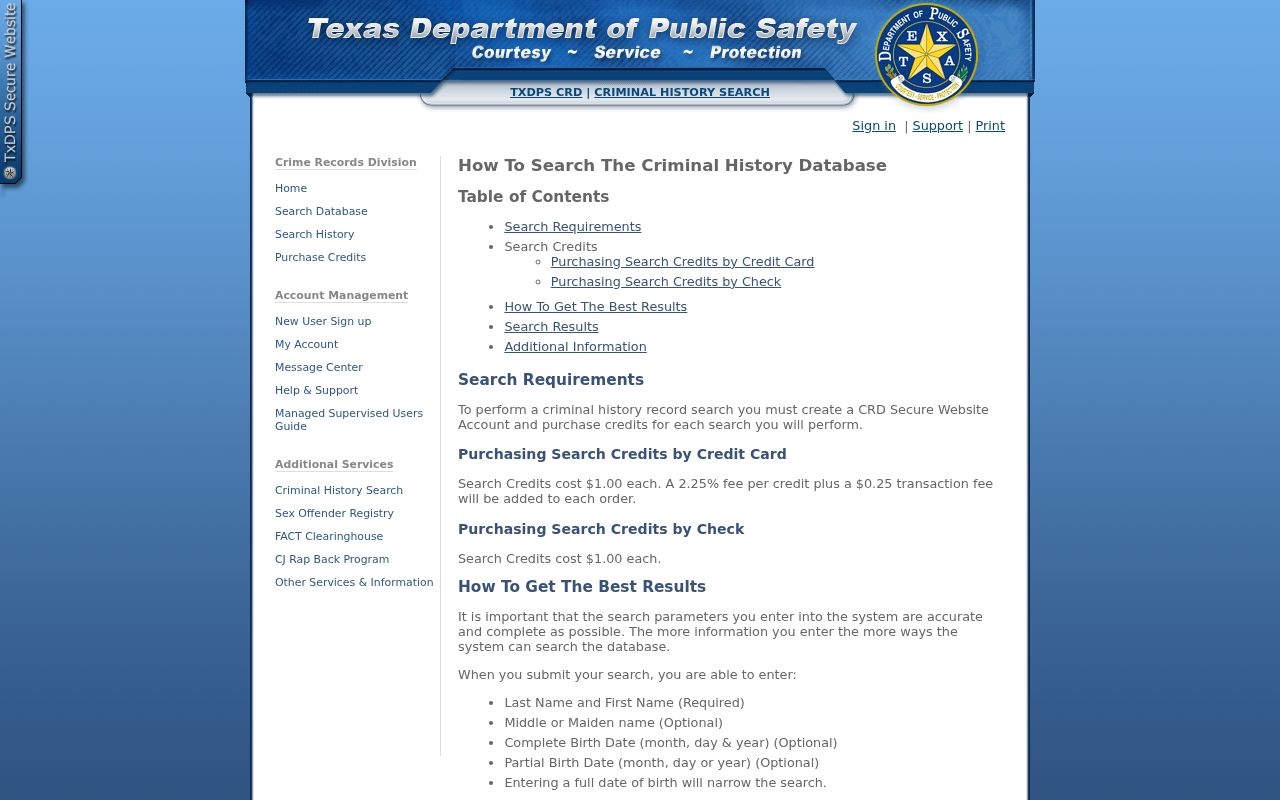
The screen is the statewide public name-search entry, not a Delta County court docket or complete fingerprint history.
Delta County Clerk Search Costs
The combined clerk at 200 West Dallas Avenue in Cooper is the local case-file hub. Written searches cost $5 per name per court, so the request should say whether to search the constitutional County Court for Class A and B misdemeanors or the 8th Judicial District for felonies. The main number is 903-395-4400, with the clerk at extension 9302 and the chief deputy at extension 9303. Published sources do not state archive years, copy prices, certified-copy prices, or turnaround times.
| Official service | Published amount |
|---|---|
| Delta clerk name search | $5 per name, per court |
| Sheriff accident or offense report | $10 |
| Sheriff search without key identifier | $5 |
| DPS public portal credit | $1, plus stated card charges |
| CR-42 mail name search | $10 per person |
| FAST personal fingerprint review | $25 stated total |
The clerk-linked payment page requires a case number. It is a payment and case-identification tool, not an open public name index.
Kinds of Criminal Records
Delta County criminal records are created by the office performing each act. Treating each source as a separate layer makes the search easier and prevents an arrest entry from being read as a conviction.
- Booking record
- A jail file for one custody episode. It may show intake facts and the charge supplied at booking.
- Court file
- A case-based file with pleadings, docket entries, orders, judgment, sentence, and costs.
- CCH
- A person-based Texas compilation tied to fingerprint and tracking reports. Full criminal-history information is not the same as the public name product.
- Warrant
- Court-issued process carried out by law enforcement. The issuing court and serving agency may hold different parts of the record.
- Nondisclosure
- A Texas order that restricts general public access but leaves authorized agency access in place.
Probation records also split. The judgment states the sentence, while operational supervision information belongs to the Community Supervision and Corrections Department and may be confidential. Parole is a distinct state process.
Delta County DPS Fingerprint Records
A name check is quick and broad enough for the public conviction product, but similar names and incomplete identifiers create uncertainty. Fingerprints are the positive-identification channel for a person reviewing their own Texas record. FAST appointments are made through IdentoGO or by calling 1-888-467-2080 during its published support hours. A requesting-agency service code and acceptable identification are normally required, and no stable official source confirmed a Delta County enrollment site.
The official FAST appointment entry lets users check current site availability.
Scheduling availability must be verified at booking rather than inferred from an old location list.
Delta County Pre-Trial Case Records
The Delta County Attorney and Hopkins County CSCD operate a voluntary pre-trial intervention program for eligible cases. The published program can consider people with limited criminal history, some participants with mental-health needs, and veterans who may benefit from education, treatment, or diversion. Acceptance is discretionary. Facts of the case, prior history, and victim impact all matter, so participation and dismissal should never be promised from a brief docket entry.
A person trying to understand their own Delta County case should still begin with the combined clerk. The court file identifies the filed charge and later disposition, while the program office manages participation details that may not be public. If successful completion leads to a dismissal, the dismissal does not by itself erase the arrest or make the record eligible for expunction. Chapter 55A and the facts of that arrest control any later petition.
Delta County Criminal Records: What They Contain
A Texas history can contain an eight-digit State Identification number, ten-character Tracking Incident Number, charge suffix, arrest date, agency identifier, agency case number, prosecution action, court, offense citation, disposition, sentence, probation, fine, and jail terms. The official Delta felony docket adds hearing-focused fields such as the setting date, bond amount, custody or bondsman notation, abbreviated charge, setting reason, court costs, fine, and comments.
| Identity fields | Name, birth data, physical descriptors, SID, and agency identifiers may appear in the appropriate state record. |
|---|---|
| Arrest and booking | Arrest date, agency, alleged offense, booking data, and custody clues can appear before a case is filed. |
| Charge | The arrest allegation, prosecutor filing, and final adjudicated offense may differ. |
| Disposition | The outcome for each charge, such as conviction, dismissal, acquittal, or deferred adjudication. |
| Sentence | Jail or prison term, fine, community supervision, and other judgment terms when reported. |
| Status | Current custody or supervision belongs to the agency responsible for that stage. |
A docket does not include the whole event log or every judgment attachment. Ask the clerk for the filed judgment when the outcome matters.
Delta County Jail and Arrest Routes
The Delta County Sheriff and Jail are published at 200 West Bonham in Cooper, with 903-395-2146 as the main line. The county homepage advertises an Inmate Listing, but its interface was not inspectable during research. The dependable fallback is to call the jail, then send a booking or offense-record request to the sheriff’s designated address at asuarez@deltacountysheriff.org. Lobby hours are Monday through Friday, 8 a.m. to 5 p.m.
Include a jailing date, offense number, or call-for-service number when known. The sheriff charges $5 to search without those identifiers. An offense report costs a separate $10. Requests are handled in receipt order, basic public information is released or the office responds within its published period of up to ten business days, and payment is due before release when a charge applies.
Combined County and District Clerk
200 West Dallas Avenue
Cooper, TX 75432
903-395-4400, ext. 9302
Delta County Sheriff and Jail
200 West Bonham
Cooper, TX 75432
903-395-2146
Lobby: Monday through Friday, 8 a.m. to 5 p.m.
One sheriff instruction page instead prints 200 West Dallas for lobby delivery. Confirm the counter before travel.
Delta County Police and Incident Records
An incident report records an event or investigation and can exist without an arrest. The creating agency remains its custodian. In much of Delta County, that route is the sheriff's designated email or lobby process. A Cooper ISD Police school event belongs first with the school-district agency, and a highway event may begin with Texas DPS. A court clerk does not become the source for the investigative report merely because a charge was later filed.
The Delta County Sheriff request instructions cover written requests for existing records. An offense or accident report costs $10, while a search can add $5 when the offense number, call-for-service number, or jailing date is missing. Requests for 911 or dispatch data, body-camera material, or an active investigation may require review and redaction. Delta County does not publish a fixed local fee or retention schedule for those media, so ask for an estimate rather than assuming the paper-report price applies.
Texas Public Access Laws
The Texas Public Information Act governs many executive-branch records, but court case files follow judicial and common-law access rules. A request to the sheriff cannot force the office to create answers or disclose confidential full criminal-history information. It also cannot replace a request to the clerk for documents filed in a case.
Key statutes:
Government Code sections 552.021 and 552.108(c) preserve access to basic information about an arrested person, arrest, or crime, subject to other law.
Government Code sections 411.083 and 411.135 protect full DPS criminal history while authorizing the narrower public product.
Code of Criminal Procedure Chapter 55A governs expunction eligibility, petitions, and the effect of an order.
Code of Criminal Procedure Chapter 62 controls sex-offender registration and the public registry fields.
Juvenile information, victim data, active investigative details, sealed material, and protected identifiers may be withheld or redacted. Basic arrest facts do not make the whole investigative file public.
Delta County Felony and Misdemeanor Records
Offense grade points to the proper Delta County court. Capital, first-degree, second-degree, third-degree, and state-jail felonies belong at the district level. The 8th Judicial District is the locally identified felony criminal court. Class A and Class B misdemeanors go to the constitutional Delta County Court, while fine-only Class C matters are heard in Justice Court or the appropriate municipal court. Delta County has no County Court at Law.
The Texas Penal Code Chapter 12 supplies the punishment ranges and enhancement rules. The judgment and charging statute control the actual grade. Classification also affects one Chapter 55A expunction route when no indictment or information was filed: the cited waiting periods are 180 days for a Class C, one year for a Class A or B, and three years for a felony. Those periods do not override the other eligibility requirements or bars.
Delta County Warrant Safe Harbor
Delta County has no verified countywide name-based warrant database. The sheriff serves warrants, the combined clerk handles county and felony court process, the Justice Court addresses Class C and traffic warrants, and Cooper Municipal Court keeps fine-only city matters. Search each possible court level and confirm status by a published number.
The Delta Justice Court warrant instructions state that a person who appears voluntarily and in good faith to resolve a Class C warrant receives safe harbor from arrest on that warrant while appearing. That rule must not be extended to a felony or Class A or B warrant. The same page warns that scammers spoof official caller ID and demand wire or prepaid payment. Call the court or sheriff independently before sending money.
Identify the issuing court, confirm the case and appearance terms, and recheck after resolution because clearance timing is not published.
Restricted, Sealed & Expunged Records
Texas now places expunction rules in Code of Criminal Procedure Chapter 55A. The statute covers several mandatory and special categories, including acquittals, certain pardons, mistaken identity, and some cases that ended without a final conviction. Waiting rules can depend on offense grade and whether an indictment or information was filed. Same-episode convictions, some supervision-violation arrests, and other statutory bars can defeat relief.
A verified petition normally goes to the district court in the county of arrest or alleged offense. The Delta County district filing fee was not located in official sources. A final order restricts release, maintenance, dissemination, or use as the statute directs. Nondisclosure is different: it limits public disclosure while preserving access for listed agencies, and it does not destroy the record.
The Texas Office of Court Administration forms separate the available nondisclosure paths.
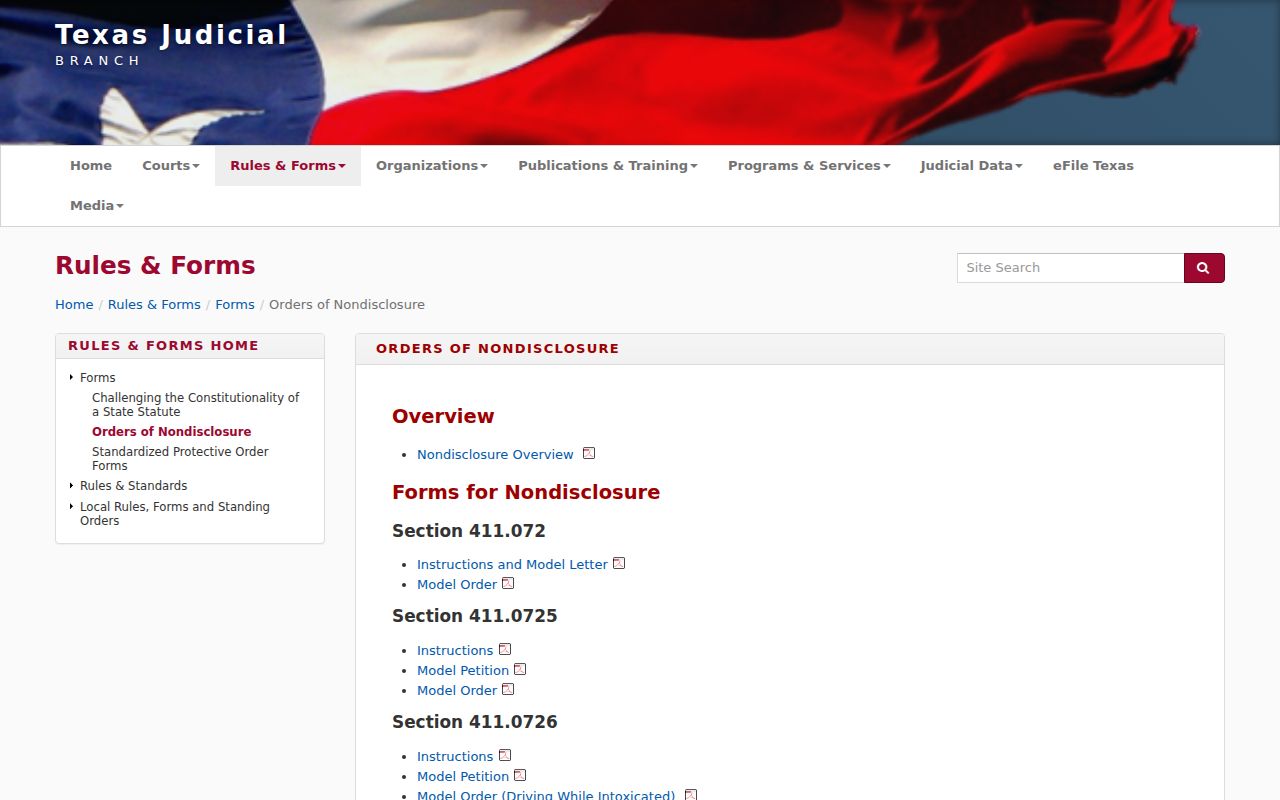
The correct form depends on the offense, date, outcome, and statutory section, so a dismissal alone does not establish eligibility.
Delta County Probation and Parole Records
Adult probation is not housed at the Delta County courthouse. Hopkins County CSCD serves Delta County from 228 Hinnant in Sulphur Springs at 903-885-7851, extension 226, with a separate Delta routing extension of 9322. There is no public statewide probation name lookup. Confirm the sentence in the clerk’s judgment, then ask the supervision office what information can lawfully be released.
Parole follows a different chain. The Texas Board of Pardons and Paroles makes release decisions, while the TDCJ Parole Division supervises releasees. The Paris District Parole Office serves the region. The TDCJ Online Inmate Search can show specified custody, conviction-county, sentence, and projected release data. It does not stand in for a Delta County jail or court file.
A motion to revoke or adjudicate may appear on a court docket when supervision is challenged. The court can continue, change, revoke, or adjudicate supervision based on the case.
City-by-City Criminal Records in Delta County
Delta County has only two incorporated cities. Cooper is the county seat and has a municipal court, but no separate city police department is documented in current city and DPS lists. Pecan Gap spans Delta and Fannin Counties, making the incident location more important than the mailing address. City citations, sheriff records, school-police incidents, and county court files each follow their own custodian.
Cooper Record Check
2020 Census population 1,911. City records use written request channels; ordinary law-enforcement routing starts with the Delta County Sheriff.
Pecan Gap Record Check
2020 Census population 178. First determine whether the event occurred on the Delta or Fannin County side.
Cooper ISD Police is a separate reporting agency for school-district incidents. A school report may stay with that agency while a later jail record goes to the sheriff and a filed case goes to the clerk.