
Cooper Criminal History Checks
Begin a Cooper criminal history check with the kind of event, not just a person’s name. No official source provides a single Cooper index. The municipal court handles its own fine-only docket, the Delta County Sheriff holds many local incident and booking files, and the combined County and District Clerk keeps filed Class A or B misdemeanor and felony cases. The Texas DPS public name search is a later statewide step for conviction and deferred-adjudication information made public by law. It is not a substitute for a fresh Cooper report or a complete local court file.
- Identify whether the event was a Cooper citation, an ordinary law-enforcement incident, or a school-police matter in Cooper.
- For Cooper-held material, send a written request to Cooper City Hall by an accepted written channel.
- Ask Cooper Municipal Court about fine-only or ordinance cases; no searchable Cooper case portal was documented.
- For an arrest, booking, Class A or B misdemeanor, or felony, move to the sheriff and the correct Delta County clerk level.
- Use Texas DPS for the reported statewide public slice, and compare any result with the originating Cooper or county record.
This order keeps unlike records apart. A booking file proves a custody event, a court file follows one prosecution, and DPS compiles reported person-based history. A missing result in one channel does not erase a record held in another.
Cooper Has Three Record Custodians
Cooper’s key record counters sit close together, yet each holds a different file. City Hall is at 91 North Side Square. The combined county clerk counter and county courts are at 200 West Dallas, while the sheriff and jail are published at 200 West Bonham. The short distance can hide a sharp legal divide. A Cooper citation belongs in the municipal file. A sheriff arrest report belongs with the sheriff. A filed misdemeanor or felony belongs with the combined clerk at the proper court level.
Ask one plain question before traveling: who created the record? “It happened in Cooper” does not answer that. If the desired item is the initial incident narrative, identify the responding agency. For the charge and outcome, identify the court shown on the citation, bond paper, or notice. When the goal is current custody, call the Delta County Jail at 903-395-2146. This custodian-first method prevents a city court search from being mistaken for a full Cooper criminal history search.
The official Cooper locations page identifies City Hall as the Cooper contact point.

Cooper City Hall is the practical address for Cooper-held requests, while county arrest and court records remain with the nearby county offices.
Records at Cooper Police Department
No separate Cooper municipal police department is currently documented in the official sources reviewed. Cooper’s department menu does not list one, and the Texas DPS approved reporting-agency list names the Delta County Sheriff and Cooper ISD Police, but not a Cooper city police agency. That evidence supports a careful routing statement: begin ordinary Cooper law-enforcement record questions with the Delta County Sheriff. It does not support a claim that a department was abolished or could never exist.
The sheriff accepts requests for sheriff-created arrest, offense, and booking material. The office publishes 200 West Bonham as its location and 903-395-2146 as its main number. Its open-records page also prints 200 West Dallas for lobby delivery, so callers should confirm the correct counter before a trip. The sheriff’s stated lobby hours are Monday through Friday, 8 a.m. to 5 p.m. Court records do not use this request route; those go to the clerk.
Note: Cooper has no documented city police records desk, so the creating agency must be identified before sending a request.
Cooper ISD Police Records Differ
Cooper ISD Police is a distinct reporting agency, not another name for a Cooper city police department. The DPS approved incident-reporting list gives the school agency its own identity, and the research lists 903-348-6294 as its contact number. A campus event may therefore begin with a school-police report even if a later jail record sits with the Delta County Sheriff and a filed case reaches a county court.
This split matters when a Cooper records search seems incomplete. Ask which officer or agency number appears on the paperwork. The arresting agency creates the initial report; the jail creates the booking record; the prosecutor and clerk create a case only if charges proceed. It can be reasonable to contact more than one custodian for the same event. Those separate requests reflect the record flow, not necessarily a lost file.
| Cooper event | Likely first contact | Record sought |
|---|---|---|
| Ordinary law-enforcement response | Delta County Sheriff | Incident, arrest, or booking material |
| School-campus police event | Cooper ISD Police | School-police incident report |
| City fine-only citation | Cooper Municipal Court | Municipal case file |
| Filed misdemeanor or felony | Combined Delta clerk | County or district court file |
Booking and Arrest Records in Cooper
No separate Cooper city jail is documented. For a recent arrest in Cooper handled through county custody, check the county’s Inmate Listing route or call the Delta County Jail, then request the sheriff record if more detail is needed. Supply a jailing date, offense number, or call-for-service number when known. The sheriff publishes a $5 locating charge when none of those three identifiers is supplied, while an offense report is listed separately at $10. Those sheriff fees should not be presented as Cooper city fees.
A Cooper arrest and a Cooper conviction are not the same record. Intake can show the charge supplied at booking. A prosecutor may later reject, amend, or file a different charge. The municipal court may retain a fine-only Cooper case, Delta County Court hears Class A and B misdemeanors, and the 8th Judicial District is the identified local felony court. The final judgment, not the initial booking label, states the adjudicated result.
For a deeper county-wide explanation of custody channels, the Delta County Arrest Search separates current jail information from historical reports and court outcomes.
Written Cooper Record Requests
The Cooper public-information request page requires writing, but it does not force the public into a proprietary online portal. A requester may obtain a form at City Hall and hand-deliver or mail it. Cooper also recognizes another written form sent to a Cooper employee, including email, fax, and letter. This gives Cooper residents several real access paths even though no unified Cooper search exists.
Cooper does not publish mandatory request fields, an identification or notarization rule, a base copy price, or a fixed response-time promise on that page. Useful locating details may still save time. State that they are drafting suggestions: include the date and location, a citation or cause number if known, a precise description of the existing record, the desired format, and a reply method. Do not ask Cooper to answer questions or create a new compilation when the goal is an existing record.
The official request page shows the city’s written options and is the source for the image below.
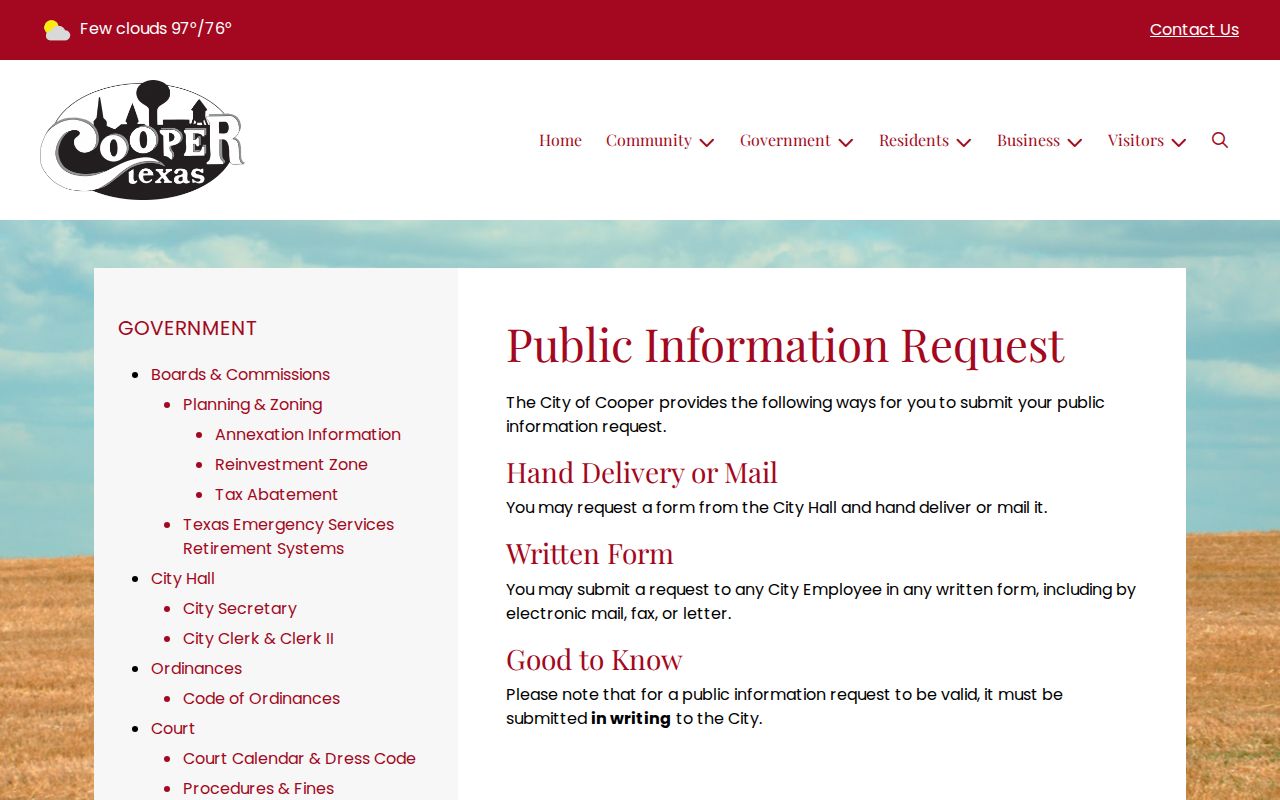
The screen reinforces Cooper’s key access rule: preserve a written copy of the request and send it through one of the city’s stated channels.
The Cooper Municipal Court File
Cooper Municipal Court handles city-level fine-only matters such as applicable ordinances, traffic cases, and Class C misdemeanors. Its official page lists 91 North Side Square, 903-395-2217, fax 903-395-0377, and coopercityhall@yahoo.com. No public name-search portal was found. The sound route is phone, counter inquiry, or a written Cooper request. The county clerk’s separate Municipal Online Payments interface requires a case number and must not be mislabeled as a Cooper municipal name search.
A municipal file can document a citation, settings, plea, judgment, fine, and related court action to the extent those items exist in that case. It will not substitute for a sheriff booking file, a Delta County misdemeanor file, or a district felony file. Ask the court which copies are available and what fees apply, because the Cooper sources reviewed do not publish a city copy schedule.
| Court Name | Cooper Municipal Court |
|---|---|
| Case Types Heard | City ordinance, traffic, and other fine-only municipal matters, including applicable Class C misdemeanors |
| Case Lookup Channel | Phone, City Hall counter, or written request; no searchable municipal portal documented |
| What the File Shows | Ask the court what exists for the identified case; no public Cooper municipal field inventory was located |
| Copies & Fees | Ask the municipal court; no official Cooper copy fee was located |
First-Thursday Cooper Court Records
The official Cooper Municipal Court page says court is held on the first Thursday of each month. That schedule is useful for appearances and warrant questions, but it does not prove records are accessible only on court day. Call City Hall to learn when the counter can handle a Cooper file request. A monthly session calendar and records access are related, not identical.
Court rules require mobile devices to be turned off and prohibit photography and audio recording, as well as food and drink. A person who wants to inspect a paper case should not assume public access includes a right to photograph it in the courtroom. Ask staff what inspection and copy method is permitted before bringing equipment or planning a visit.
The court page also supplies the source view shown here.

Its published schedule and contact route make direct confirmation more reliable than treating an unrelated county payment tool as the city docket.
How Cooper Records Reach the County
A Cooper event does not always stay at city level. A fine-only city citation may remain with Municipal Court. A sheriff arrest can generate a jail booking, then a prosecutor decision and a county or district case. For Class B or greater arrests, Texas reporting rules use fingerprints and linked identifiers as agencies report arrest, prosecution, and disposition events to DPS. The combined Delta clerk states that it reports dispositions to the Office of Court Administration and DPS.
Record flow: Cooper city or responding agency › Delta County Sheriff and proper court › Texas Department of Public Safety
Timing explains why the sources can disagree. A fresh sheriff record may exist before a court filing. A docket can show a setting without the final result. DPS may receive the disposition later, and its public name product is narrower than full criminal-history record information. For a missing DPS outcome, obtain a certified disposition from the court of jurisdiction; DPS says an ordinary unsealed copy is not enough for correction.
Note: Compare records by source and date before deciding that a Cooper entry is wrong or missing.
Cooper City Ticket or County Crime
The charge level points to the right Cooper record holder. Municipal and justice courts hear fine-only Class C matters. Delta County Court handles Class A and B misdemeanors, while the District Court handles felonies. This split means a municipal search can correctly return no result even though a county criminal case exists. The reverse is also possible: a city citation can remain in Cooper Municipal Court without creating a Delta County Court criminal file.
- Complaint
- A sworn allegation that may begin a lower-level case.
- Information
- A prosecutor’s charging instrument commonly used for a misdemeanor case.
- Indictment
- A grand-jury accusation used for a felony prosecution.
- Disposition
- The result reached for a charge, such as conviction, acquittal, or dismissal.
Use the heading on a citation, bond form, or hearing notice to confirm the forum. When no paperwork remains, give the city or county clerk the person’s name and a date range, then state which court level should be searched. The combined Delta clerk charges $5 per name per court for a written search, so naming the court level matters.
Cooper Records in County-Seat Context
Cooper was incorporated in 1887 and is a General Law Type A city. The 2020 Census counted 1,911 residents, making it Delta County’s largest incorporated city. A newer Texas Municipal League figure of 2,025 uses another vintage, so the two totals should not be blended as though measured on the same date. Cooper’s small scale and county-seat role help explain why city, sheriff, jail, and court contacts are close in distance but not merged in law or record custody.
The county’s criminal courts and combined clerk occupy the courthouse, while City Hall keeps Cooper municipal business. Modern case-management work does not change the public route. The county adopted Enterprise Justice in 2024, yet the clerk still says criminal case records are not online. Likewise, the existence of written Cooper channels does not create a citywide criminal database. Direct requests remain essential for both local systems.
Cooper Record Access Rules
Texas law assigns different access rules to police records, court files, and statewide criminal history. The Texas Public Information Act can reach existing city or sheriff records, and Government Code Section 552.108(c) preserves basic facts about an arrested person, an arrest, or a crime from the ordinary law-enforcement exception unless another law controls. Investigative details, protected victim data, juvenile material, and other confidential content can still be withheld.
Court case files follow court and clerk access rules, not the sheriff’s public-information route. Full DPS criminal-history record information is confidential, while the public product releases the narrower conviction and deferred-adjudication information authorized by law. A Cooper request cannot turn confidential DPS data or a judicial case file into an open city record.
Key Statutes:
Texas Government Code Chapter 552 gives access to public records and preserves basic arrest and crime facts under Sections 552.021 and 552.108(c).
Texas Government Code Sections 411.083 and 411.135 keep full DPS history confidential while authorizing the prescribed public conviction search.
The Texas DPS CCH reporting guide explains how Code of Criminal Procedure Chapter 66 links qualifying arrests, prosecution actions, and dispositions.