
Criminal Court Cases in Delta County
Delta County divides criminal court cases by charge level. The 8th Judicial District is the locally identified felony court. The constitutional Delta County Court hears Class A and Class B misdemeanors and appeals from lower courts. Delta has no County Court at Law, despite a templated phrase on one county page. The official Texas trial-court inventory confirms that point, so requests should name the constitutional County Court rather than a court that does not exist.
The combined County and District Clerk keeps both the misdemeanor and felony case files at 200 West Dallas Avenue in Cooper. The same office reports dispositions to the Office of Court Administration and Texas DPS. Justice Court handles fine-only and traffic matters, magistrate work, and warrants. Cooper Municipal Court keeps city and fine-only matters at 91 North Side Square. Each lower court remains the custodian of its own file, even when an appeal later reaches Delta County Court.
This split affects what a search returns. A sheriff arrest report will not contain every motion, plea, order, or judgment filed in a Delta County criminal court case. Likewise, a clerk file may not contain the full investigative narrative or jail intake record. Start with the document needed, then choose its custodian. For a felony judgment, use the District Clerk side of the combined office. For a Class A or B misdemeanor judgment, name the constitutional County Court. For a traffic or fine-only case, ask the issuing Justice or Municipal Court.
Delta County Courts by Case Level
A charge label alone may not reveal which desk holds the record. Start with the alleged grade of offense and the court shown on any citation, bond paper, docket notice, or cause number. The 62nd Judicial District has general district-court jurisdiction, but Delta's local materials describe the 8th Judicial District as the felony criminal court and the 62nd mainly as civil. That local division matters when a broad state court description points to more than one possible district court.
| Court | Delta County case role | Contact |
|---|---|---|
| 8th Judicial District | Felony criminal cases | 200 W. Dallas; 903-438-4022 |
| Constitutional County Court | Class A/B misdemeanors and lower-court appeals | Clerk ext. 9303 |
| Justice Court | Fine-only, traffic, magistrate, and warrant matters | Clerk ext. 9306 |
| Cooper Municipal Court | City and fine-only matters | 903-395-2217 |
The combined counter reduces travel, but it does not merge the legal identity of the courts. A $5 name search applies per name and per court. If the offense level is unclear, provide the cause number or copies of the paperwork and ask staff which court should be searched. The 8th Judicial District judge's office uses 903-438-4022. The combined clerk's main number is 903-395-4400, with extension 9302 for the clerk and extension 9303 for the chief deputy. These contacts help resolve routing; the clerk, not the judge's office, remains the case-file custodian.
Delta County Case Record Searches
The clerk says Delta County records are not online at present. Online docket PDFs can reveal scheduled hearings, while the linked payment interface can locate a known cause number. Neither is a public name index. The dependable route is a written or counter search through the combined clerk. A name search costs $5 per name, per court, so specify misdemeanor County Court or felony District Court rather than asking for an undefined countywide search.
- Identify the court level from the charge, citation, docket, or existing paperwork.
- Review the official misdemeanor dockets for a scheduled setting, but treat each PDF as a dated snapshot.
- If the cause number is known, enter it in the county-linked payment search to confirm the payment record.
- Ask the combined clerk for a $5 name search in the correct court when no cause number is available.
- Request the needed filed document, judgment, or certified disposition directly from the clerk. Published prices beyond the name search were not located.
Written access is especially important because the clerk expressly says the files are not online. A request should give the full name used in the case, the likely court, and a cause number if known. Ask for the exact record that answers the question, such as the information, indictment, docket sheet, judgment, sentence, or certified disposition. A broad demand for a “criminal history” can point to several systems and may not tell staff which Delta County case file to retrieve.
| Field Label | Type | Required | Notes |
|---|---|---|---|
| Case number | Text | Yes | The only inspected search field in the payment tool |
Note: Delta County publishes no archive range, copy price, certification price, or stated turnaround for criminal case-file requests.
Official docket PDFs are useful before contacting the clerk. They may show a scheduled setting, court, case number, and shorthand charge. Yet a docket can change after publication, and it may omit the result. The payment tool is narrower still. Use these online pieces to collect identifiers, then verify the operative order in the clerk's file. This method prevents a hearing calendar or payment balance from being mistaken for the final court record.
Delta County Payment Search Limits
The clerk links to a Municipal Online Payments case search, but the label can sound broader than the tool is. It requires a case number. There is no inspected field for a party name, birth date, filing year, or charge. Use it to reach a known payment record, not to decide whether someone has a Delta County criminal case.
The official case-number payment search shows the single-field entry screen:
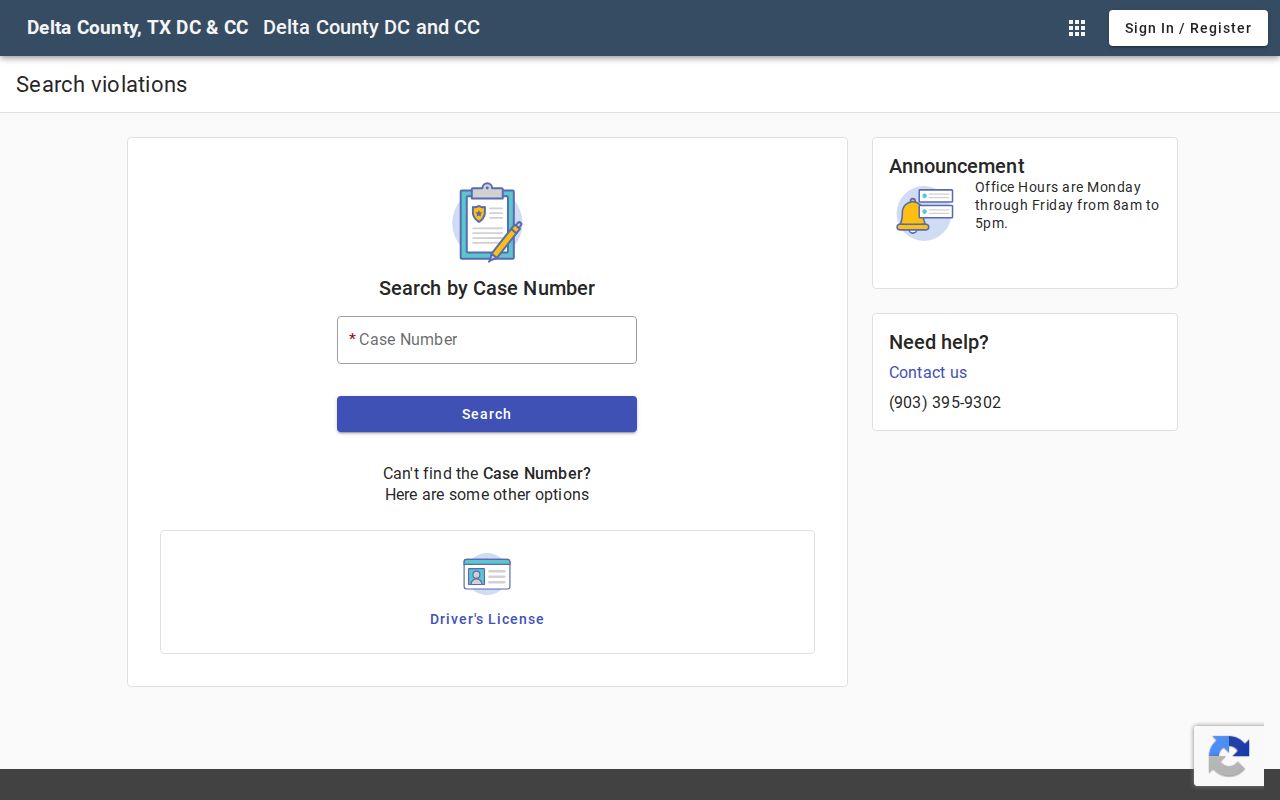
This interface explains why the clerk's written name search remains essential when the cause number is unknown. It also prevents a no-result screen from being mistaken for proof that no court file exists.
The phrase “case search” on a payment vendor can create a local trap. Delta County's inspected screen accepts only the case number, so it cannot discover an unknown file by first and last name. It also does not publish the court's complete docket, charging instrument, plea, or judgment. If a reader knows only a name, the correct path is the clerk's paid name search. If a reader knows the cause number but needs proof of outcome, the payment result is still not enough; request the disposition.
What a Criminal Case File Contains
A Delta County criminal case file follows a single prosecution. It may contain the complaint, information, or indictment; motions and orders; hearing entries; plea papers; judgment; sentence; and cost records. This differs from a jail booking, which covers one custody event, and from DPS criminal history, which compiles person-based reports. The filed judgment and certified disposition are the strongest sources for the court's final result.
| Case Number & Court | Identifies the cause and the Delta County court that owns the file. |
|---|---|
| Charging Document | Shows the complaint, information, or indictment and the filed allegation. |
| Docket Entries | Lists recorded settings, filings, orders, and procedural events. |
| Hearing Dates | Shows arraignment, pretrial, trial, revocation, or sentencing settings. |
| Disposition & Judgment | States dismissal, acquittal, conviction, deferred adjudication, or another outcome. |
| Sentence & Conditions | Records lawful jail, fine, supervision, community service, or other terms. |
The most useful document depends on the task. A charging paper identifies what the state filed, not necessarily the eventual result. A docket traces procedure but may use short labels. The judgment records the outcome, and the sentence states the court's ordered terms. When DPS shows an arrest with no result, ask for a certified disposition rather than a general copy of the file. Certified means the clerk has authenticated the record with the official seal.
One case file does not equal a person-wide Delta County criminal history. Separate causes may exist in different courts, and a lower-court traffic matter will not appear in the felony file. Search each plausible court when the goal is to review one's own local records. The statewide DPS compilation can add reported Texas events, but it depends on agency reporting and is not a substitute for the source judgment.
Reading a Delta County Felony Docket
The inspected official felony docket carries setting date, case number, filed date, party style, attorneys, bondsman or custody location, bond amount, abbreviated charge, setting reason, offense date, hearing time, costs, fine, comments, pass count, and jail or hold notations. Setting reasons may include arraignment, pretrial, sentencing, motion to revoke or proceed, bench trial, or a hire-attorney setting.
A docket does not supply a complete event history, every charging statute, judgment attachments, victim data, full sentence, restitution ledger, or a conclusive disposition. Read it as a calendar and status clue. Then request the filed judgment or order. Terms also matter: an arraignment is the charge-and-plea hearing, while a disposition is the result of a charge. Deferred adjudication delays a finding during supervision and does not mean the record vanished.
- Information
- A prosecutor's charging instrument, commonly used for a misdemeanor.
- Indictment
- A grand jury's felony accusation.
- Capias
- A court writ directing that a person be arrested.
- Disposition
- The recorded outcome of a filed charge.
The docket's bond and custody fields also need care. A bondsman name, “Delta Co Jail” entry, cash-only notation, or bond amount can describe status at the time of the setting. Those fields do not provide every release condition or later change. Comments and pass counts may explain scheduling, yet they do not establish guilt. Readers who need the current order should ask the clerk which filed document controls.
Courthouse rules can affect an in-person review. Delta County's published County Court conduct rules ban unapproved recorders, computers, cameras, and other electronics. Cell phones are prohibited, and the rules warn against a ringing phone. Ask the clerk about permitted note-taking or copies before arriving. The county does not publish full parking, locker, transit, security-screening, or accessibility details, so a brief call can prevent a failed visit.
Criminal Case Stages in Delta County
A misdemeanor can begin with a complaint or information, or arrive as an appeal from a lower court. The clerk opens the Delta County case. A summons or warrant may issue, followed by a first appearance, notice of rights, and an arraignment plea. Discovery and motions prepare the matter for a negotiated plea or trial. The court then enters judgment and imposes any sentence. Exact timing is case-specific, and no local source publishes a standard duration for each stage.
Case flow: Charges Filed › Arraignment › Pretrial › Plea or Trial › Disposition › Sentencing
A felony begins through the proper charging process and proceeds in District Court. A misdemeanor information belongs in the constitutional County Court. At arraignment, the accused hears the filed charge and enters a plea. Pretrial work can include discovery requests and motions. A plea agreement can resolve the case without trial, but the court must still enter the disposition and sentence. If the state does not proceed, the record should be checked for the actual dismissal or other filed order rather than inferred from a missing future setting.
When re:SearchTX Finds No Delta Case
re:SearchTX is a statewide electronic document service, not a complete Texas criminal index. A Texas Judicial Council report states that its large document collection dating to 2016 excludes criminal case records. A blank result therefore should not end a Delta County court case lookup. Return to the combined clerk, the dated local docket PDFs, or the lower court that originated the matter.
The official re:SearchTX interface illustrates the statewide service, but its reach must be read with the published criminal-record limitation:
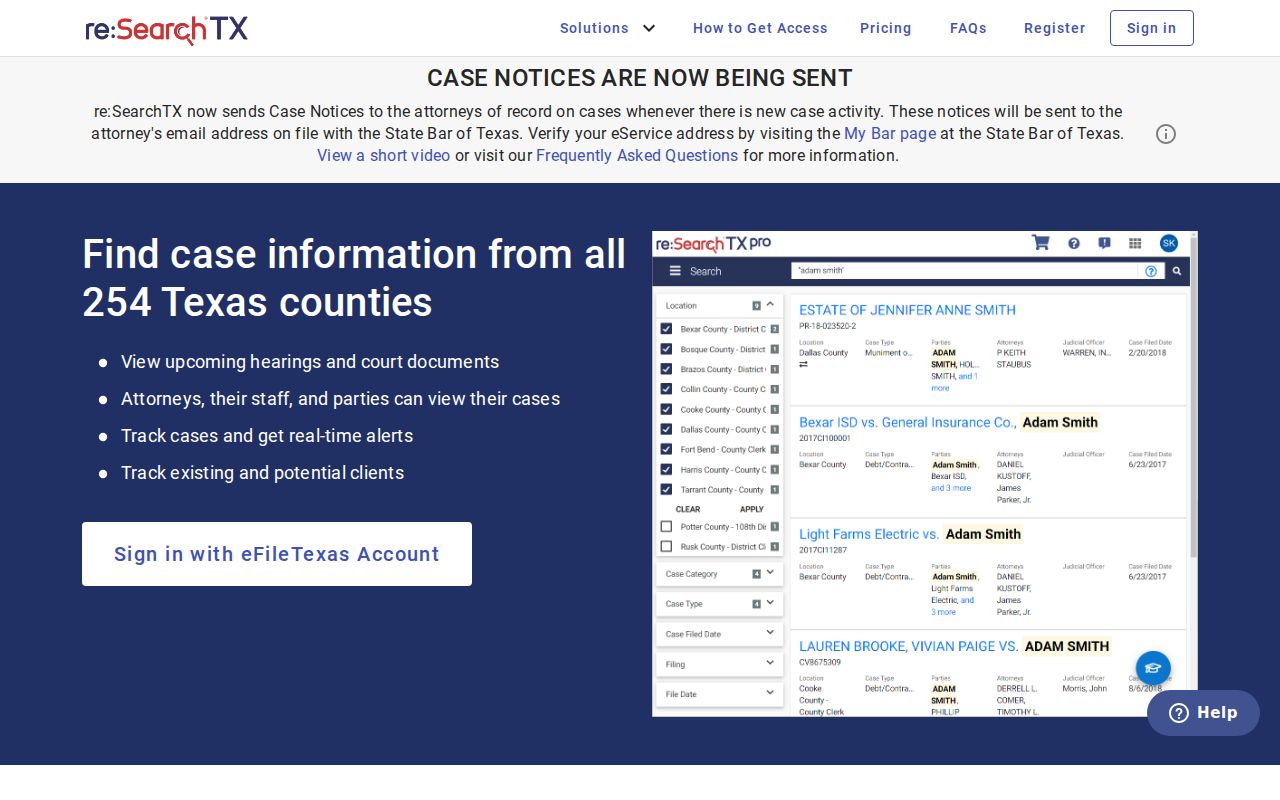
The safest fallback is court-specific. Ask the clerk to search the felony District Court or misdemeanor County Court by name. For a fine-only matter, contact Justice Court or Cooper Municipal Court instead.
Statewide coverage can also lag or omit a local paper record. re:SearchTX participation, electronic filing, and document access do not alter the Delta clerk's statement that county records are not presently online. Older material is particularly likely to require the counter or a written inquiry because no official archive dates were published. Supply the filing year or offense date if known, but do not invent a date-range limit for the clerk's holdings.
Access Rules for Case Records
Court case files do not follow the sheriff's Texas Public Information Act route. Government Code §552.0035 places the judiciary outside that act, and Texas Rule of Judicial Administration 12 treats filed case records differently from judicial administrative records. Request a Delta County criminal file from the clerk under court-access procedures. Sending the request to the sheriff cannot turn court documents into law-enforcement records.
Access does not make every detail public. Juvenile material, protected victim information, sealed files, expunged records, and material restricted by another law may be withheld or redacted. An online absence may also reflect an offline or older file. Call clerk extension 9302 or 9303 before travel if the needed record, archive year, copy format, or certification price is unclear.
Texas Government Code §§552.021 and 552.108(c) govern public-information access and basic law-enforcement information, but they do not convert filed judicial records into sheriff records. Full DPS criminal-history information is separately confidential under §411.083, while §411.135 authorizes a narrower public product. Chapter 55A expunction and Government Code nondisclosure provisions can further restrict access. These separate rules explain why the same name may produce a public docket clue, no online clerk file, and a limited DPS result.
Correcting a Delta County Disposition
A DPS result can lack a disposition even when the Delta County court has finished the case. DPS says this may happen when a court submission never arrived or was returned because of an error. The remedy is not to infer an outcome from a docket. Obtain a certified disposition from the court of jurisdiction and use the DPS correction route.
The seal matters. DPS states that an ordinary photocopy is not enough for this correction. First confirm which Delta County court entered the result, ask that clerk for the certified judgment or disposition, and keep the cause number tied to the request. This step reconciles the court file with the statewide person-based report without treating either record as interchangeable.
The reporting identifiers help agencies join the events. Texas uses a ten-character Tracking Incident Number for the arrest and a suffix for each charge. DPS can also use an eight-digit SID, the agency ORI, and its case number. Prosecutors report acceptance, rejection, or modification, while court clerks submit the disposition. A correction request should therefore preserve the name, cause number, court, and certified result so DPS can match the right reported charge.